MathPath
MathPath adapts to how you're doing, reads every question aloud, and now offers an aphasia-friendly mode that swaps word problems for plain equations. Invite a therapist or caregiver to follow your progress if you choose. Also works well as straightforward math practice, Pre-K through college.
No ads. Cancel any time before the trial ends and you're not charged.
Already a subscriber? Sign in
Four steps, from first sign-in to tracked progress.
Or skip it and choose a level yourself — it's a suggestion, not a requirement.
Correct answers over time raise the difficulty; missed ones lower it, unit by unit.
A therapist, caregiver, or parent can follow your progress, if you want them to.
Completed units are saved automatically, and each level earns a Certificate.
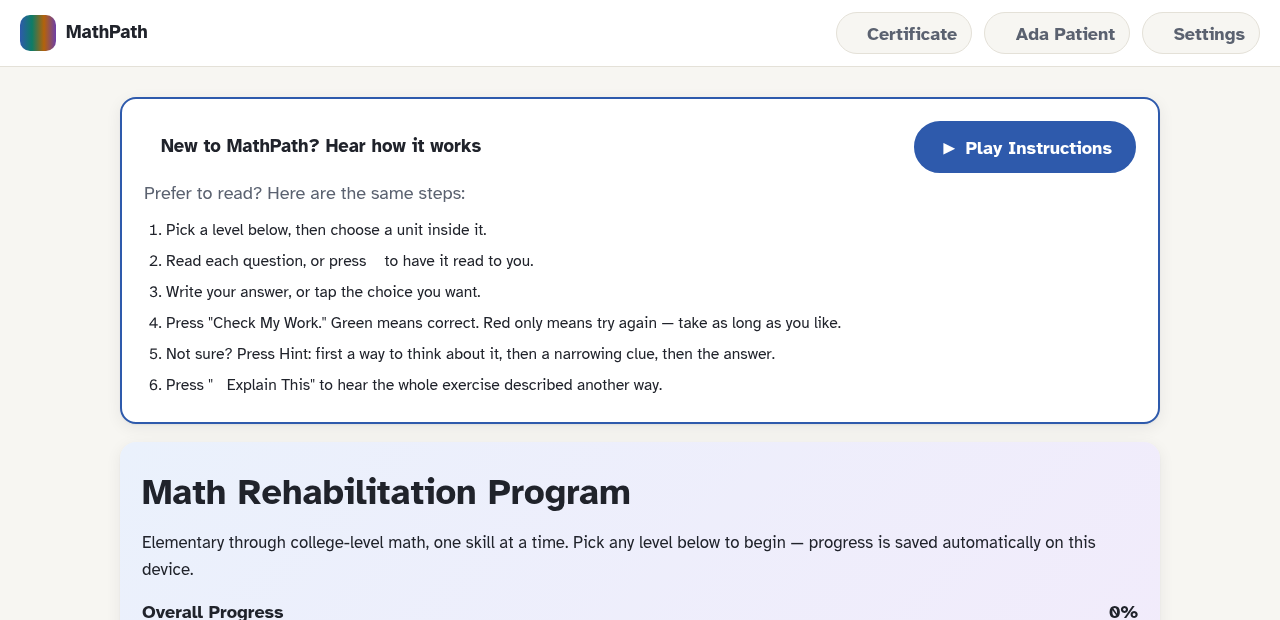
Some people use MathPath as part of a rehabilitation or care plan after a stroke, a brain injury, or another change that affects cognitive skills. Every question and instruction can be read aloud. Difficulty adjusts unit by unit based on recent answers, rather than staying fixed to a grade level. For patients with aphasia, whose language comprehension can be affected even when their math sense is intact, an aphasia-friendly mode can show word problems as plain equations instead, or highlight the numbers and key words within them. A patient can invite a therapist or caregiver to see their progress, without sharing a password or handing over the account itself.
MathPath is not a medical device and is not a substitute for professional medical, psychological, or therapeutic care. If you use it as part of a rehabilitation or care plan, it is a supplement to that care, not a replacement for guidance from your licensed provider.
MathPath also works as a straightforward math practice tool outside of any care plan: homeschool review, tutoring support, or brushing up before the next grade.
Both plans include a 7-day free trial. Cancel any time before the trial ends and you're not charged.
Is MathPath a substitute for therapy or medical care?
No. MathPath is not a medical device and is not a substitute for professional medical, psychological, or therapeutic care. If you use it as part of a rehabilitation or care plan, it is a supplement to that care, not a replacement for guidance from your licensed provider.
Does MathPath work for someone with aphasia?
Yes. An aphasia-friendly mode can show word problems as plain equations instead of a written sentence, or highlight the numbers and key words within them, since aphasia can affect language comprehension even when math sense is intact. MathPath is not a medical device and is not a substitute for professional medical, psychological, or therapeutic care. If you use it as part of a rehabilitation or care plan, it is a supplement to that care, not a replacement for guidance from your licensed provider.
Is MathPath appropriate for stroke or brain injury recovery?
Some people use MathPath as part of a rehabilitation or care plan after a stroke, brain injury, or another change that affects cognitive skills. Difficulty adjusts automatically and every question can be read aloud. MathPath is not a medical device and is not a substitute for professional medical, psychological, or therapeutic care. If you use it as part of a rehabilitation or care plan, it is a supplement to that care, not a replacement for guidance from your licensed provider.
What ages or levels does MathPath cover?
Fifteen skill levels, from Pre-K arithmetic through college algebra. A short Placement Check can suggest a starting point, or you can pick a level yourself.
Can a caregiver or therapist see my progress?
Only if you invite them. They see a read-only view of your practice progress on their own account, and you can remove their access at any time.
Is there a free trial?
Yes. Both the monthly and yearly plans include a 7-day free trial. Cancel before the trial ends and you are not charged.
Do I need an account to use MathPath?
Yes. An account and an active subscription are required to practice. There is no ad-supported free tier.
One account. Fifteen levels. No ads.
Start Your 7-Day Free Trial